

The U-channel generator creates U-channels (channel sections) in Alibre Design as 3D parts that comply with the standard. Only the type, section and length are selected.
Requirement for the script: Alibre Design Pro or Expert from V29 (Alibre Script is not included in Atom3D). Compare editions (in German)
The dimensions of the cross-section
Both types are described by the same basic dimensions:
- h: section height
- b: flange width
- tw: web thickness
- tf: flange thickness
- r1: root radius at the inner corner of the web
- r2: toe radius at the flange tip (UPN only)
- sf: flange taper in per cent (UPN only)
With UPE, there is no flange taper, and the flange tip is sharp-edged (no r2).
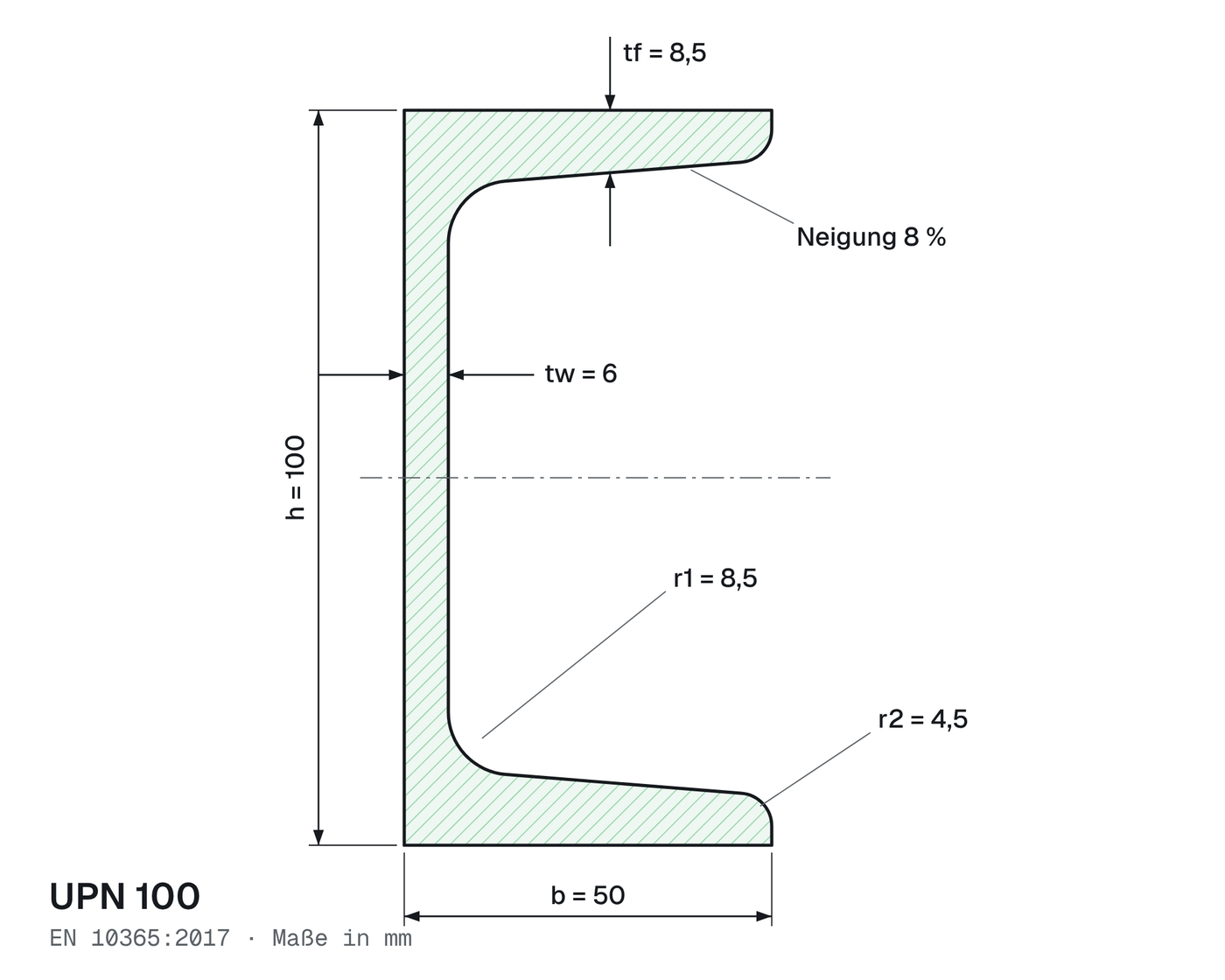
Cross-section UPN 100 according to EN 10365:2017, dimensions in mm.
Dimension table UPN
| Section | h | b | tw | tf | r1 | r2 | sf [%] |
|---|---|---|---|---|---|---|---|
| UPN 50 | 50 | 38 | 5.0 | 7.0 | 7.0 | 3.5 | 8 |
| UPN 65 | 65 | 42 | 5.5 | 7.5 | 7.5 | 4.0 | 8 |
| UPN 80 | 80 | 45 | 6.0 | 8.0 | 8.0 | 4.0 | 8 |
| UPN 100 | 100 | 50 | 6.0 | 8.5 | 8.5 | 4.5 | 8 |
| UPN 120 | 120 | 55 | 7.0 | 9.0 | 9.0 | 4.5 | 8 |
| UPN 140 | 140 | 60 | 7.0 | 10.0 | 10.0 | 5.0 | 8 |
| UPN 160 | 160 | 65 | 7.5 | 10.5 | 10.5 | 5.5 | 8 |
| UPN 180 | 180 | 70 | 8.0 | 11.0 | 11.0 | 5.5 | 8 |
| UPN 200 | 200 | 75 | 8.5 | 11.5 | 11.5 | 6.0 | 8 |
| UPN 220 | 220 | 80 | 9.0 | 12.5 | 12.5 | 6.5 | 8 |
| UPN 240 | 240 | 85 | 9.5 | 13.0 | 13.0 | 6.5 | 8 |
| UPN 260 | 260 | 90 | 10.0 | 14.0 | 14.0 | 7.0 | 8 |
| UPN 280 | 280 | 95 | 10.0 | 15.0 | 15.0 | 7.5 | 8 |
| UPN 300 | 300 | 100 | 10.0 | 16.0 | 16.0 | 8.0 | 8 |
| UPN 320 | 320 | 100 | 14.0 | 17.5 | 17.5 | 8.8 | 5 |
| UPN 350 | 350 | 100 | 14.0 | 16.0 | 16.0 | 8.0 | 5 |
| UPN 380 | 380 | 102 | 13.5 | 16.0 | 16.0 | 8.0 | 5 |
| UPN 400 | 400 | 110 | 14.0 | 18.0 | 18.0 | 9.0 | 5 |
All dimensions in millimetres.
Dimension table UPE
| Section | h | b | tw | tf | r1 |
|---|---|---|---|---|---|
| UPE 80 | 80 | 50 | 4.0 | 7.0 | 10.0 |
| UPE 100 | 100 | 55 | 4.5 | 7.5 | 10.0 |
| UPE 120 | 120 | 60 | 5.0 | 8.0 | 12.0 |
| UPE 140 | 140 | 65 | 5.0 | 9.0 | 12.0 |
| UPE 160 | 160 | 70 | 5.5 | 9.5 | 12.0 |
| UPE 180 | 180 | 75 | 5.5 | 10.5 | 12.0 |
| UPE 200 | 200 | 80 | 6.0 | 11.0 | 13.0 |
| UPE 220 | 220 | 85 | 6.5 | 12.0 | 13.0 |
| UPE 240 | 240 | 90 | 7.0 | 12.5 | 15.0 |
| UPE 270 | 270 | 95 | 7.5 | 13.5 | 15.0 |
| UPE 300 | 300 | 100 | 9.5 | 15.0 | 15.0 |
| UPE 330 | 330 | 105 | 11.0 | 16.0 | 18.0 |
| UPE 360 | 360 | 110 | 12.0 | 17.0 | 18.0 |
| UPE 400 | 400 | 115 | 13.5 | 18.0 | 18.0 |
All dimensions in millimetres.
Two types according to EN 10365:2017
The dimensions of both types are combined in EN 10365:2017 (formerly DIN 1026-1 for UPN, DIN 1026-2 for UPE).
For equal and unequal leg angles, DIN EN 10056-1 is a separate dimensional standard. Dimensions, weights and materials for these are covered in the article Steel angle table: L-sections with dimensions, weights and standards.
UPN has tapered flanges: the inner faces of the flanges are bevelled towards the flange tip. The taper is 8 % for heights up to 300 mm and 5 % above. UPN is the classic series that has been available for a long time.
UPE has parallel flanges: the inner faces run parallel to the outer face, and the flange has a constant thickness over its entire width. At the same height, UPE sections are generally wider and have a higher load-bearing capacity than UPN.
Frequently asked questions
What is the difference between UPN and UPE?
UPN has tapered flanges: the inner faces slope towards the tip, by 8 % for heights up to 300 mm and by 5 % above. UPE has parallel flanges with constant thickness and no radius r2. At the same height, UPE sections are generally wider and have a higher load-bearing capacity.
What are the dimensions of a UPN 100?
According to EN 10365:2017, a UPN 100 has a height of 100 mm, a flange width of 50 mm, a web thickness of 6.0 mm and a flange thickness of 8.5 mm. The radii are r1 = 8.5 mm and r2 = 4.5 mm, the flange taper is 8 %.
Which standard applies to U-channels?
The dimensions of UPN and UPE are combined in EN 10365:2017. Formerly, DIN 1026-1 applied to UPN and DIN 1026-2 to UPE. For steel angles, DIN EN 10056-1 is a separate dimensional standard.
The script
The U-channel generator is an AlibreScript for Alibre Design V29. After starting, a dialog opens with three inputs:
- Type: UPN or UPE
- Section: the list of sections adapts automatically to the selected type
- Length: the section length in millimetres
Clicking “OK” creates a new part in its own Alibre window. The cross-section is created as a fully constrained, dimensioned sketch made of individual lines; the sketch dimensions have meaningful names (b, tf, h and so on) and can be found in the equation editor. The radii r1 (and for UPN also r2) are applied as fillets to the longitudinal edges. This makes it quick to build up a whole series of lengths for each section.
Note
The community tools are provided free of charge to the Alibre user community. Maintenance and further development are carried out independently by O-Punkt CAD GmbH. Use is without warranty. For safety-critical designs, always cross-check the results. Feedback and suggestions for improvement are welcome.