
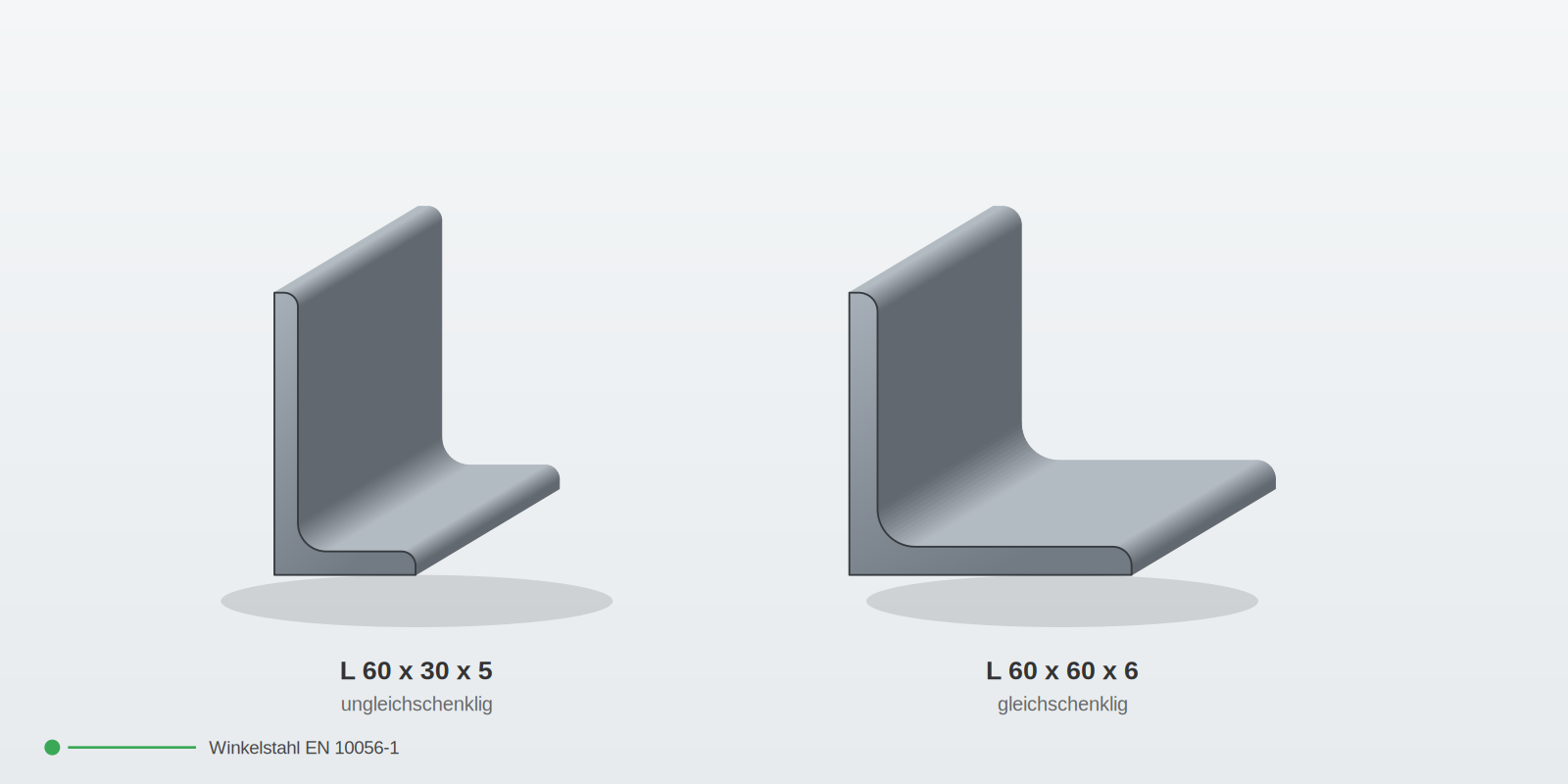
Frames, bracing, brackets, supports: steel angles, also called L-sections or angle irons in the trade, are found wherever a lot of stiffness is needed from a small cross-section. This article covers the standards for the German-speaking countries, the designation, the weights of common sections and the choice of material.
All values are metric and refer to European standards (EN/DIN EN). Sources using inch dimensions and ASTM standards do not apply here.
Requirement for the script: Alibre Design Pro or Expert from V29 (Alibre Script is not included in Atom3D). Compare editions (in German)
For U-channels, EN 10365 is a separate dimensional standard. The two types UPN and UPE with their cross-section dimensions are described in the article U-channels UPN and UPE: dimension table to EN 10365.
Dimension and weight tables
The following values are theoretical weights from supplier data sheets referring to the standard (DIN EN 10056-1 / -2), calculated with the standard density of 7.85 kg/dm³. Real values vary depending on the mill and batch within the tolerances.
Equal leg angles (selection of common sizes)
| Designation | a (mm) | t (mm) | r₁ inner (mm) | r₂ outer (mm) | Weight (kg/m) |
|---|---|---|---|---|---|
| L 35 × 35 × 4 | 35 | 4 | 5.0 | 2.5 | 2.09 |
| L 35 × 35 × 5 | 35 | 5 | 5.0 | 2.5 | 2.57 |
| L 40 × 40 × 4 | 40 | 4 | 6.0 | 3.0 | 2.42 |
| L 40 × 40 × 5 | 40 | 5 | 6.0 | 3.0 | 2.97 |
| L 40 × 40 × 6 | 40 | 6 | 6.0 | 3.0 | 3.52 |
| L 45 × 45 × 5 | 45 | 5 | 7.0 | 3.5 | 3.38 |
| L 50 × 50 × 5 | 50 | 5 | 7.0 | 3.5 | 3.77 |
| L 50 × 50 × 6 | 50 | 6 | 7.0 | 3.5 | 4.47 |
| L 50 × 50 × 7 | 50 | 7 | 7.0 | 3.5 | 5.15 |
| L 50 × 50 × 8 | 50 | 8 | 7.0 | 3.5 | 5.82 |
| L 60 × 60 × 5 | 60 | 5 | 8.0 | 4.0 | 4.57 |
| L 60 × 60 × 6 | 60 | 6 | 8.0 | 4.0 | 5.42 |
| L 60 × 60 × 7 | 60 | 7 | 8.0 | 4.0 | 6.26 |
Unequal leg angles (selection checked against ArcelorMittal)
Designation as L h × b × t, where h is the longer and b the shorter leg. r₁ = inner radius (root), r₂ = edge radius (leg ends). Values according to DIN EN 10056-1:2017-06.
| Designation | h (mm) | b (mm) | t (mm) | r₁ inner (mm) | r₂ outer (mm) | Weight (kg/m) |
|---|---|---|---|---|---|---|
| L 30 × 20 × 3 | 30 | 20 | 3 | 4.0 | 2.0 | 1.12 |
| L 30 × 20 × 4 | 30 | 20 | 4 | 4.0 | 2.0 | 1.46 |
| L 40 × 20 × 4 | 40 | 20 | 4 | 4.0 | 2.0 | 1.77 |
| L 40 × 25 × 4 | 40 | 25 | 4 | 4.0 | 2.0 | 1.93 |
| L 45 × 30 × 4 | 45 | 30 | 4 | 4.5 | 2.25 | 2.25 |
| L 50 × 30 × 5 | 50 | 30 | 5 | 5.0 | 2.5 | 2.97 |
| L 60 × 30 × 5 | 60 | 30 | 5 | 6.0 | 3.0 | 3.36 |
| L 60 × 40 × 5 | 60 | 40 | 5 | 6.0 | 3.0 | 3.76 |
| L 60 × 40 × 6 | 60 | 40 | 6 | 6.0 | 3.0 | 4.46 |
| L 65 × 50 × 5 | 65 | 50 | 5 | 6.0 | 3.0 | 4.35 |
| L 70 × 50 × 6 | 70 | 50 | 6 | 7.0 | 3.5 | 5.41 |
| L 75 × 50 × 6 | 75 | 50 | 6 | 7.0 | 3.5 | 5.64 |
| L 75 × 50 × 8 | 75 | 50 | 8 | 7.0 | 3.5 | 7.39 |
| L 80 × 40 × 6 | 80 | 40 | 6 | 7.0 | 3.5 | 5.41 |
| L 80 × 40 × 8 | 80 | 40 | 8 | 7.0 | 3.5 | 7.07 |
| L 80 × 60 × 7 | 80 | 60 | 7 | 8.0 | 4.0 | 7.36 |
| L 100 × 50 × 6 | 100 | 50 | 6 | 8.0 | 4.0 | 6.84 |
| L 100 × 50 × 8 | 100 | 50 | 8 | 8.0 | 4.0 | 8.95 |
| L 100 × 65 × 7 | 100 | 65 | 7 | 10.0 | 5.0 | 8.79 |
| L 100 × 65 × 8 | 100 | 65 | 8 | 10.0 | 5.0 | 9.97 |
| L 100 × 65 × 10 | 100 | 65 | 10 | 10.0 | 5.0 | 12.25 |
| L 100 × 75 × 8 | 100 | 75 | 8 | 10.0 | 5.0 | 10.60 |
| L 100 × 75 × 10 | 100 | 75 | 10 | 10.0 | 5.0 | 13.03 |
| L 100 × 75 × 12 | 100 | 75 | 12 | 10.0 | 5.0 | 15.46 |
| L 120 × 80 × 8 | 120 | 80 | 8 | 11.0 | 5.5 | 12.17 |
| L 120 × 80 × 10 | 120 | 80 | 10 | 11.0 | 5.5 | 14.99 |
| L 120 × 80 × 12 | 120 | 80 | 12 | 11.0 | 5.5 | 17.82 |
| L 125 × 75 × 8 | 125 | 75 | 8 | 11.0 | 5.5 | 12.17 |
| L 125 × 75 × 10 | 125 | 75 | 10 | 11.0 | 5.5 | 14.99 |
| L 125 × 75 × 12 | 125 | 75 | 12 | 11.0 | 5.5 | 17.82 |
| L 135 × 65 × 8 | 135 | 65 | 8 | 11.0 | 5.5 | 12.17 |
| L 135 × 65 × 10 | 135 | 65 | 10 | 11.0 | 5.5 | 14.99 |
| L 150 × 90 × 10 | 150 | 90 | 10 | 12.0 | 6.0 | 18.21 |
| L 150 × 90 × 12 | 150 | 90 | 12 | 12.0 | 6.0 | 21.59 |
| L 150 × 90 × 15 | 150 | 90 | 15 | 12.0 | 6.0 | 26.61 |
| L 150 × 100 × 10 | 150 | 100 | 10 | 12.0 | 6.0 | 19.00 |
| L 150 × 100 × 12 | 150 | 100 | 12 | 12.0 | 6.0 | 22.53 |
| L 200 × 100 × 10 | 200 | 100 | 10 | 15.0 | 7.5 | 22.92 |
| L 200 × 100 × 12 | 200 | 100 | 12 | 15.0 | 7.5 | 27.32 |
| L 200 × 100 × 15 | 200 | 100 | 15 | 15.0 | 7.5 | 33.76 |
| L 200 × 150 × 12 | 200 | 150 | 12 | 15.0 | 7.5 | 32.03 |
| L 200 × 150 × 15 | 200 | 150 | 15 | 15.0 | 7.5 | 39.64 |
Here too, r₂ = r₁ / 2. The static values (I, W, distances to the centroidal axes eᵧ, e_z) are not listed; they are given in Table 2 of the standard and in the section property tables of steel stockholders.
Note on data verification: masses and radii were cross-checked against several independent sources according to EN 10056-1 (section tables referring to the standard, a second EN 10056-1 table, the ArcelorMittal 2018 data set and a 3D catalogue part). The radius of L 60×30 was confirmed on the real catalogue part (6.0/3.0). Only sections whose dimensions and radii can be verified against a traceable source are included. Sections that cannot be clearly verified (such as L 150×75, which is not listed in the ArcelorMittal range and whose radius differs between table sources) are deliberately not included; special sizes can be derived independently if required.
Which standards apply
For hot-rolled angles made of structural steel, four areas of standards are relevant in the German-speaking countries. Dimensions and tolerances are governed by separate standards. This differs from the former German system (DIN 1028 for equal leg, DIN 1029 for unequal leg angles), which combined both for each section shape.
| Subject | Standard (edition) | Content |
|---|---|---|
| Dimensions | DIN EN 10056-1:2017-06 | Nominal dimensions of hot-rolled equal and unequal leg angles |
| Tolerances | DIN EN 10056-2:1993 (German edition 1994-03) | Limit deviations, shape tolerances, permissible deviations of mass |
| Material (non-alloy structural steel) | EN 10025-2 | Technical delivery conditions, e.g. S235JR, S355J2 |
| Material (stainless) | EN 10088 | Stainless steel grades, e.g. 1.4301, 1.4401 |
Two points are important:
- EN 10056-1 explicitly applies only to hot-rolled angles and not to stainless steels. In practice, stainless steel angles are often supplied according to the same dimension tables, but formally the stainless steel standards (EN 10088) apply there. This is a confirmed statement of the standard, not an interpretation.
- The editions of the standards mentioned in this article should be checked. EN 10056-1:2017-06 and EN 10056-2:1993 have been verified. For EN 10025 and EN 10088, you should check the currently valid edition with the supplier or in the DIN catalogue before placing a binding order.
A brief history
Before the age of steel, wrought iron was used for bridge, ship and building frames; angles were forged and their leg lengths were often uneven. The Bessemer process (1856) reduced the cost of steel production and made it more uniform. From the 1870s onwards, hot-rolled L-sections appeared in standardised form, initially mainly for railway bridges, ship hulls and industrial structures.
Designation and structure
An angle section is described by three dimensions, each in millimetres:
- Leg width a: width of the first leg
- Leg width b: width of the second leg (for equal leg angles, a = b)
- Thickness t: material thickness
The standardised short designation begins with the code letter L, followed by the dimensions, for example:
L 50 × 50 × 5
L 100 × 50 × 8   (unequal leg)
In addition, there are two radii that are relevant for design and CAD: the root radius at the inner corner (usually listed as root radius in the standard tables) and the smaller edge radius at the leg ends. Anyone reproducing a section true to size in CAD should take these radii from the table for the respective size and not model with sharp 90° corners; otherwise the cross-sectional area and mass will not be correct.
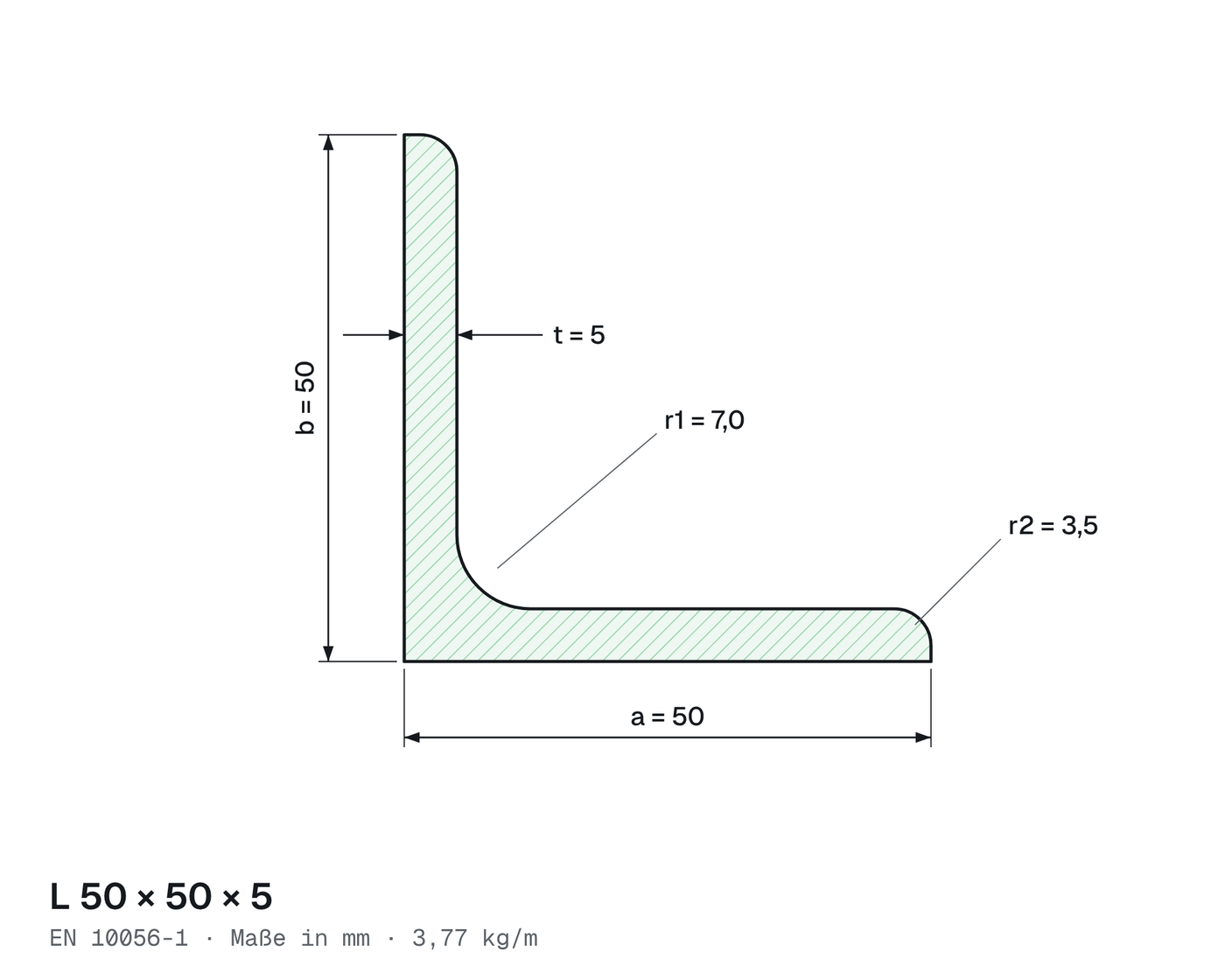
Steel angle L 50 × 50 × 5 according to EN 10056-1, dimensions in mm.
Equal leg or unequal leg
Equal leg (a = b). Symmetrical cross-section, even load-bearing about both leg axes. Suitable for frames, shelving and welded structures where the load comes from several directions or the installation position is not fixed.
Unequal leg (a ≠ b). One leg is longer. This increases the moment of inertia about the corresponding axis and thus the bending stiffness in a preferred direction. Useful when the load direction is known and the longer leg is deliberately placed there, for example perpendicular to the expected bending. Typical in trusses, reinforcements and wherever a symmetrical section would be unnecessarily heavy.
So the difference is not only geometric. With targeted alignment, an unequal leg section can be stiffer in the governing direction than a heavier equal leg section. That is the actual design advantage.
Inner and edge radii of equal leg angles (for CAD and fits)
Hot-rolled angles have two standardised radii, which are specified in EN 10056-1 for each size:
- r₁, inner radius (root): the fillet at the inner corner of the L
- r₂, edge radius (leg ends): the rounding at the leg tips
Throughout, r₂ = r₁ / 2 applies. The static values in the standard tables are calculated with this ratio. For equal leg angles, both radii depend only on the leg width a, not on the material thickness t: a 50 × 50 × 5 and a 50 × 50 × 8 have the same inner radius. For unequal leg angles, this simplification does not apply; their radii are listed per section in the complete dimension table above.
| Leg width a (mm) | r₁ inner (mm) | r₂ outer (mm) |
|---|---|---|
| 20 | 3.5 | 1.8 |
| 25 | 3.5 | 1.8 |
| 30 | 5.0 | 2.5 |
| 35 | 5.0 | 2.5 |
| 40 | 6.0 | 3.0 |
| 45 | 7.0 | 3.5 |
| 50 | 7.0 | 3.5 |
| 60 | 8.0 | 4.0 |
| 65 | 9.0 | 4.5 |
| 70 | 9.0 | 4.5 |
| 75 | 9.0 | 4.5 |
| 80 | 10.0 | 5.0 |
| 90 | 11.0 | 5.5 |
| 100 | 12.0 | 6.0 |
| 120 | 13.0 | 6.5 |
| 130 | 14.0 | 7.0 |
| 150 | 16.0 | 8.0 |
| 160 | 17.0 | 8.5 |
| 180 | 18.0 | 9.0 |
| 200 | 18.0 | 9.0 |
| 250 | 18.0 | 9.0 |
Note on symbols: EN 10056-1 designates the inner radius as r₁ and the edge radius as r₂. Some section tables swap the indices or write r and r₁; if in doubt, go by the description (inner/outer), not by the index.
Consequence for CAD: anyone modelling a hot-rolled section true to size applies the inner radius r₁ at the root and the edge radius r₂ at both leg ends. If modelled with sharp 90° corners, the cross-sectional area, and therefore mass and static values, deviate from the standard section. Cold-formed angles, on the other hand, have a considerably smaller inner radius (depending on the bending tool, not according to EN 10056-1) and usually sharp cut edges at the leg ends. This table does not apply there.
Rough estimation formula
If you want to roughly estimate a section that is not tabulated, you can calculate:
Mass [kg/m] ≈ 0.00785 × (a + b − t) × t (a, b, t in mm)
Example L 50 × 50 × 5: 0.00785 × (50 + 50 − 5) × 5 = 3.73 kg/m.
The table gives 3.77 kg/m. The formula slightly underestimates the real value because it ignores the radii: the inner radius adds more material in the corner area than the rounded leg ends remove. For a structural calculation, the table values must therefore be used, not the formula.
Materials and grades
| Grade | Standard | Type | Typical use |
|---|---|---|---|
| S235JR | EN 10025-2 | Non-alloy structural steel | General steel construction, easy to weld |
| S355J2 | EN 10025-2 | Non-alloy structural steel, higher strength | Load-bearing structures, higher loads |
| 1.4301 (X5CrNi18-10) | EN 10088 | Stainless | Indoor use, mildly corrosive environment |
| 1.4401 (X5CrNiMo17-12-2) | EN 10088 | Stainless, alloyed with molybdenum | Coastal, swimming pool, chemical environment |
In addition:
- S235JR is the grade most commonly stocked in the trade for steel angles (formerly St 37-2 or S235JRG2). Economical, easy to weld and drill.
- S355J2 has a higher yield strength and is common for more highly stressed structures.
- 1.4301 covers general stainless steel requirements; 1.4401 with added molybdenum is preferable for marine or chemically aggressive environments.
- Hot-dip galvanising is not a steel grade of its own but a zinc layer on structural steel (S235/S355) and is applied according to EN ISO 1461. It protects against corrosion but does not increase tensile strength or yield strength. The load-bearing capacity depends solely on the base material.
If you want to store these grades in Alibre Design for mass or strength considerations, the procedure is described in the article Creating and maintaining materials in the material editor. In the supplied library, only the density is filled in for most materials.
Example of an outdoor application on the coast: structural steel S235 with hot-dip galvanising according to EN ISO 1461 combines sufficient strength with corrosion protection; where appearance or a particularly aggressive environment requires it, stainless steel 1.4401 is the alternative.
Assumption/practical note, not an equivalence of standards: US texts mention ASTM A36 and A992. In practice, A36 is roughly compared with S235 and A992 roughly with S355. Chemically and mechanically, these grades are not identical. Equating them in an order or structural calculation is not permissible; the respective standardised European grade is decisive. (In the US standards, A992 is also primarily intended for rolled beams, not for angles.)
Tolerances and incoming inspection
According to EN 10056-2, the following limit deviations, among others, are common (values from supplier data sheets referring to the standard; if in doubt, consult the standard itself):
- Leg width: up to 50 mm ± 1.0 mm; up to 100 mm ± 2.0 mm; up to 150 mm ± 3.0 mm; up to 200 mm ± 4.0 mm
- Leg thickness: up to 5 mm ± 0.5 mm; up to 10 mm ± 0.75 mm
- Straightness and squareness: governed separately in the standard; for dimensionally critical fits, check the supplier's dimensional drawing
On delivery, it makes sense to check: leg widths and thickness against the tolerance, the surface for mill scale, rust or pitting, and straightness over the bar length.
Hot-rolled or cold-formed
The most visible difference is the inner corner.
Hot-rolled. The steel is heated above the recrystallisation temperature and formed by rolling with rounded section grooves. At this temperature, a sharp inner corner cannot be produced; a root radius (fillet) is created. This radius is not a defect: it reduces the stress concentration in the corner and is an advantage when welding. For the same reason, the outer edges of hot-rolled sections are also slightly rounded. This is a consequence of the rolling geometry; the cross-sectional area remains within tolerance. Most structural steel angles are hot-rolled; EN 10056-1 refers exclusively to this product form.
Cold-formed. Flat sheet or strip steel is bent at room temperature on a press brake or roll former. The bending radius is smaller, the inner corner appears almost sharp, the dimensions are tighter and the appearance more uniform. Cold-formed angles are preferred for brackets, housings, architectural details and light structures, where clean edges are more important than maximum load-bearing capacity.
Design note: if a mating part is to fit flush into the inner corner of a hot-rolled angle, the root radius must be taken into account, usually via a chamfer or a small clearance on the mating part.
Selection for a specific project
Selection essentially follows four criteria:
- Load and stress: higher loads require a larger cross-section and/or higher strength (S355 instead of S235). The calculation is decisive, not intuition.
- Environment: outdoors, in damp or corrosive environments, choose hot-dip galvanised structural steel or stainless steel.
- Processing: non-alloy structural steel is the easiest to weld and drill.
- Installation position: with unequal leg sections, place the longer leg in the governing load direction.
Processing: three practical points
- Welding galvanised angles: the zinc layer must be ground off in the weld zone, otherwise harmful zinc fumes and poor weld penetration result. After welding, touch up the area with zinc dust paint or zinc spray. When welding galvanised material, the relevant occupational safety and extraction requirements apply (in Germany, among others, the TRGS rules); this is an obligation of the person carrying out the work, not an optional note.
- Drilling and sawing: HSS or cobalt drills for structural steel, carbide for stainless steel, with coolant/lubricant against overheating. Cutting with band saw, chop saw or plasma.
- Rust: surface rust is usually only cosmetic. Pitting, on the other hand, reduces the cross-sectional area and thus the load-bearing capacity. Blasting, priming or galvanising prevents long-term damage.
Stock lengths
Common stock lengths in the metric trade are 6 m, sometimes also 12 m. Many dealers cut to the desired length for a surcharge. Shipping of long goods is often limited to certain lengths (frequently up to 3 m); above that, sometimes only collection is possible. This needs to be clarified with the supplier.
Frequently asked questions
How heavy is steel angle L 50 × 50 × 5?
An equal leg angle L 50 × 50 × 5 according to EN 10056-1 weighs 3.77 kg/m, calculated with the standard density of 7.85 kg/dm³. Real weights vary within the tolerances. The inner radius is 7.0 mm, the edge radius 3.5 mm.
What radii does a steel angle have?
Every hot-rolled angle has an inner radius r1 at the inner corner and a smaller edge radius r2 at the leg ends, with r2 = r1 / 2. For equal leg angles, both radii depend only on the leg width: L 50 × 50 × 5 and L 50 × 50 × 8 have the same inner radius.
Equal leg or unequal leg: what is the difference?
With an equal leg angle, both legs are the same length and the cross-section is symmetrical. It is suitable when loads come from several directions. With an unequal leg angle, one leg is longer. Placed in the load direction, it can be stiffer there than a heavier equal leg section.
Standards used (summary)
- DIN EN 10056-1:2017-06, Structural steel equal and unequal leg angles, Part 1: Dimensions
- DIN EN 10056-2:1993 (German edition 1994-03), Part 2: Tolerances on shape and dimensions
- EN 10025-2, Hot rolled products of structural steels, non-alloy structural steels (S235, S355 etc.)
- EN 10088, Stainless steels
- EN ISO 1461, Hot dip galvanized coatings on fabricated iron and steel articles
The predecessors of the dimensional standards were DIN 1028 (equal leg) and DIN 1029 (unequal leg).
As of 31 May 2026. Check the editions of standards and table values with the supplier or in the DIN catalogue before binding use.