

Anyone designing in CAD needs screws all the time, and usually not as a single item but in series across several sizes, lengths and property classes. This article covers the five most common metric screw standards: head types and drive, shank or full thread, the designation, the ISO metric thread, the wrench sizes and the property classes.
All values are metric according to ISO. Sources using inch threads (UNC/UNF) and their own standards (ASME/SAE) do not apply here.
The matching generator, the Schrauben-Master for Alibre Design, is available via the download button above. It creates the screws described here parametrically as 3D parts. The tool section further below explains this in detail.
Requirement for the script: Alibre Design Pro or Expert from V29 (Alibre Script is not included in Atom3D). Compare editions (in German)
Which standards the generator covers
The Schrauben-Master covers five metric ISO standards. They differ in head type and drive and in whether the screw has a plain shank or a continuous thread.
| Standard | Designation | Head / drive | Thread |
|---|---|---|---|
| ISO 4014 | Hexagon head bolts with shank | external hexagon | partial thread (with shank) |
| ISO 4017 | Hexagon head screws threaded to the head | external hexagon | full thread |
| ISO 4762 | Hexagon socket head cap screws | cylindrical head, hexagon socket | full thread |
| ISO 7380-1 | Hexagon socket button head screws | button head, hexagon socket | full thread |
| ISO 10642 | Hexagon socket countersunk head screws | 90° countersunk head, hexagon socket | full thread |
For orientation: ISO 4762 corresponds to DIN 912, formerly common in Germany, ISO 10642 to DIN 7991, ISO 4014 to DIN 931 and ISO 4017 to DIN 933. The old DIN numbers are still widespread in the trade; dimensionally, ISO and DIN are identical apart from a few wrench sizes (see the section “Wrench sizes”).
Head types and drive
Two types of drive occur:
External hexagon (ISO 4014, 4017). The hexagon is on the outside of the head and is tightened with an open-end, ring or socket wrench. Advantage: high transmittable tightening torques, robust even with dirty or slightly damaged heads. Disadvantage: space is needed at the side for the wrench.
Hexagon socket (ISO 4762, 7380-1, 10642). The hexagon is recessed into the head as a socket and is operated with a hex key (Allen key). Advantage: little space needed at the side, countersinkable heads, clean appearance. Disadvantage: smaller wrench sizes than an external hexagon of the same thread size, and therefore more prone to rounding out with excessive torque or worn tools.
The head types in detail:
- Cylindrical head (ISO 4762): cylindrical head with a flat bearing face, projects above the surface. Standard for high-strength bolted joints in mechanical engineering.
- Button head (ISO 7380-1): low, domed head. Flatter than the cylindrical head, visually unobtrusive, lower permissible preload.
- Countersunk head (ISO 10642): conical 90° head that disappears flush into a countersink. For smooth surfaces where nothing may protrude.
Shank or threaded to the head
The most important difference between ISO 4014 and ISO 4017 is not the head type (that is identical) but the thread length.
ISO 4014 (with shank, partial thread). A plain, unthreaded shank remains below the head; only the lower part carries a thread. The shank is useful if the bolt is to act as a fit or take up transverse forces via the shank cross-section (shear load), or if the clamping length is large and the thread should not lie in the joint.
ISO 4017 (threaded to the head, full thread). The thread runs continuously up to the underside of the head. An advantage with thin clamped parts or when the engagement depth is to be variable. For pure shear connections, a full thread in the loaded cross-section is less favourable, because the core cross-section is smaller than the shank cross-section.
Design note: with very short lengths, a partial thread according to ISO 4014 can no longer be represented geometrically. Then ISO 4017 (full thread) is the right choice. This is also the reason why both standards exist side by side.
Systematic designation
A screw is uniquely designated by standard, thread, length and property class. Scheme:
Hexagon head bolt ISO 4014 - M10 × 50 - 8.8
Here, M10 is the metric coarse thread, 50 the nominal length in millimetres and 8.8 the property class. For countersunk and button head screws, the overall length including the countersunk head is measured; for screws with a head that sits on the surface (hexagon, cylindrical), the length counts from the underside of the head.
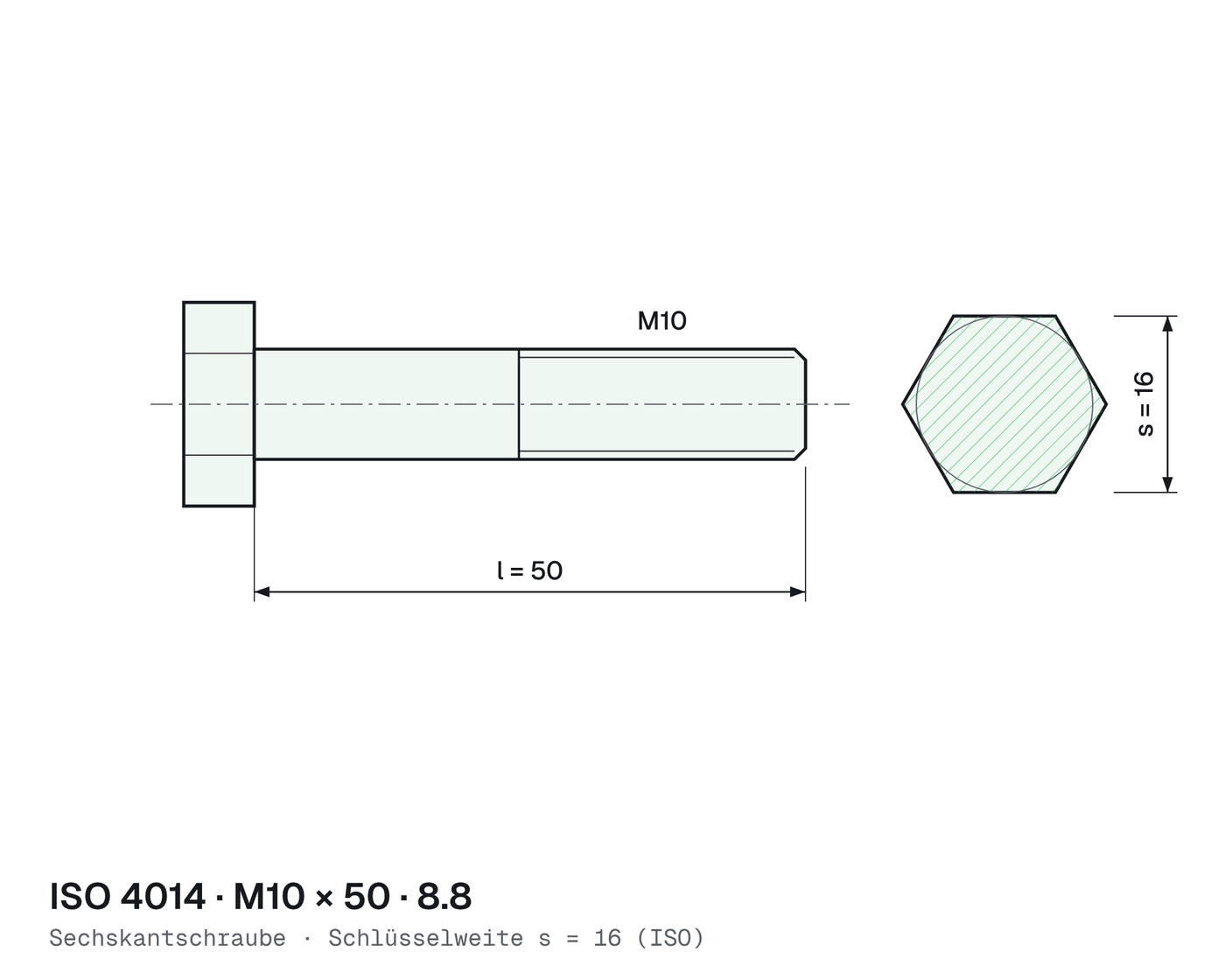
Hexagon head bolt ISO 4014 M10 × 50, wrench size 16 mm according to ISO.
The Schrauben-Master automatically writes this information into the properties of the 3D part, including “Description” (e.g. “Sechskantschraube ISO 4017 - M6 x 20 - 8.8”), “Number” (e.g. “ISO 4017-M6x20-8.8”) and “Material” (e.g. “Stahl 8.8”). This means the screw can later be clearly identified in bills of materials and drawings.
ISO metric thread and pitch
All five standards use the ISO metric coarse thread according to ISO 261. The letter M stands for metric, the number is the major (nominal) diameter in millimetres. Each nominal diameter has a fixed pitch P (distance between two adjacent thread turns).
| Thread | Nominal diameter d (mm) | Pitch P, coarse thread (mm) |
|---|---|---|
| M3 | 3 | 0.5 |
| M4 | 4 | 0.7 |
| M5 | 5 | 0.8 |
| M6 | 6 | 1.0 |
| M8 | 8 | 1.25 |
| M10 | 10 | 1.5 |
| M12 | 12 | 1.75 |
| M14 | 14 | 2.0 |
| M16 | 16 | 2.0 |
| M20 | 20 | 2.5 |
| M24 | 24 | 3.0 |
In addition to the coarse thread, there are fine threads with a smaller pitch (e.g. M10 × 1.25 or M10 × 1). Fine threads are used, among other things, where finer adjustment, higher self-locking or more load-bearing thread turns in thin-walled components are required. The standard parts mentioned here have coarse threads as standard.
The ISO metric thread must be distinguished from the Whitworth pipe thread used in gas and water installation, which is still specified in inches today. How this system came about and how it relates to DN and PN is explained in the article Pipe dimensions table: DN, PN and wall thickness.
Wrench sizes and hexagon socket
This is where the most common stumbling block lies, namely with the external hexagon screws.
When changing over from the old DIN standards (DIN 931/933) to ISO (ISO 4014/4017), four wrench sizes were changed. Anyone using the old tool here risks rounding off the head.
| Thread | Wrench size ISO (mm) | formerly DIN (mm) |
|---|---|---|
| M5 | 8 | 8 |
| M6 | 10 | 10 |
| M8 | 13 | 13 |
| M10 | 16 | 17 |
| M12 | 18 | 19 |
| M14 | 21 | 22 |
| M16 | 24 | 24 |
| M20 | 30 | 30 |
| M22 | 34 | 32 |
| M24 | 36 | 36 |
Confirmed by the standard: only M10, M12, M14 and M22 (bold) were changed. All other wrench sizes are identical in ISO and DIN. In practice, both variants are still in circulation. So when buying tools or replacement screws, pay attention to ISO or DIN.
With hexagon socket screws, the wrench size (dimension across the flats of the socket) is considerably smaller than with an external hexagon of the same thread size. For socket head cap screws according to ISO 4762 (= DIN 912):
| Thread | Hexagon socket (mm) |
|---|---|
| M3 | 2.5 |
| M4 | 3 |
| M5 | 4 |
| M6 | 5 |
| M8 | 6 |
| M10 | 8 |
| M12 | 10 |
| M14 | 12 |
| M16 | 14 |
| M20 | 17 |
Important note: because of their flatter heads, button head (ISO 7380-1) and countersunk head (ISO 10642) screws have their own, usually smaller hexagon socket sizes (e.g. M6 typically 4 mm instead of 5 mm, M8 typically 5 mm instead of 6 mm). The data sheet of the respective standard is decisive here, not the table for ISO 4762.
Property classes
For steel screws, the property class indicates the mechanical characteristics. It is standardised in ISO 898-1 and consists of two numbers separated by a dot, for example 8.8. The logic behind it is mathematically unambiguous:
- First number × 100 = tensile strength Rm in MPa (example 8.8 → 800 MPa).
- First number × second number × 10 = yield strength Re in MPa (example 8.8 → 8 × 8 × 10 = 640 MPa). The second number is therefore the ratio of yield strength to tensile strength (here 0.8).
| Class | Tensile strength Rm (MPa) | Yield strength Re or Rp0.2 (MPa) | Note |
|---|---|---|---|
| 4.6 | 400 | 240 | low strength |
| 5.6 | 500 | 300 | |
| 5.8 | 500 | 400 | |
| 6.8 | 600 | 480 | |
| 8.8 | 800 | 640 | most common standard |
| 10.9 | 1000 | 900 | high strength |
| 12.9 | 1200 | 1080 | highest usual class |
A different system applies to stainless screws (ISO 3506). Here there is a material group (A2, A4) and a property class (e.g. 70, 80), where the class × 10 gives the tensile strength: A2-70 and A4-80 correspond to 700 and 800 MPa. Compared with A2, A4 is alloyed with molybdenum and is therefore more resistant to pitting and crevice corrosion (sea water, chlorides).
Materials and corrosion protection
The most common material groups:
- Quenched and tempered steels and case-hardening steels for classes 8.8 to 12.9. Higher classes are stronger but more brittle and more sensitive to hydrogen-induced brittle fracture. This must be considered with electroplated zinc coating of high-strength screws (10.9, 12.9).
- Stainless steels A2 (e.g. 1.4301 / X5CrNi18-10) and A4 (alloyed with molybdenum, e.g. 1.4401). A4 for marine and chemically aggressive environments.
- Surfaces: electroplated zinc (thin, decorative, limited corrosion protection), hot-dip galvanised (thicker, more robust; less common for screws because of thread tolerances), or coated (e.g. zinc flake).
Safety-relevant, not a design: property class and material are not a cosmetic specification. For load-bearing or safety-relevant connections, the class is part of the structural calculation; it must not be chosen “by feel” or swapped arbitrarily when replacing.
Frequently asked questions
What wrench size does an M10 screw have?
According to ISO 4014 and ISO 4017, an M10 hexagon head screw has a wrench size of 16 mm, whereas according to the old standards DIN 931 and DIN 933 it is 17 mm. Only M10, M12, M14 and M22 were changed. The hexagon socket according to ISO 4762 has a wrench size of 8 mm for M10.
What does property class 8.8 mean?
The property class according to ISO 898-1 consists of two numbers. The first times 100 gives the tensile strength, so 800 MPa for 8.8. The first times the second number times 10 gives the yield strength, here 640 MPa. The second number is the ratio of yield strength to tensile strength.
What is the pitch of an M10 thread?
According to ISO 261, the metric coarse thread M10 has a pitch of 1.5 mm. In addition, there are fine threads with a smaller pitch, such as M10 × 1.25 or M10 × 1. They are used, among other things, for finer adjustment or higher self-locking.
Creating screws directly in Alibre
The Schrauben-Master is an AlibreScript tool (IronPython) for Alibre Design. It creates the five standard screws described above parametrically.
This is how the tool works:
- A single dialog with four selection fields: standard, size, nominal length and property class. The lists are filtered dynamically: after choosing the standard, only the sizes valid for it appear, then only the valid lengths and classes.
- Each screw created is set up as a separate 3D part in a new Alibre tab. This allows entire series to be created in quick succession.
- The standard designation, size, length, property class and material are automatically written into the part properties (Description, Number, Material, Comment); in addition, technical values are stored as parameters (d, L, b, P, s, e, k). This makes bills of materials and drawing annotation easier.
The tool is available free of charge for private and commercial use. Download via the button above or in the Tools & scripts section.
For orientation, without warranty: the Schrauben-Master reproduces the standardised geometry for design and visualisation purposes. For safety-critical calculations, the dimensions and strength values must be checked against the currently valid standard or data sheet.
Standards used (summary)
- ISO 4014: Hexagon head bolts with shank (formerly DIN 931)
- ISO 4017: Hexagon head screws threaded to the head (formerly DIN 933)
- ISO 4762: Hexagon socket head cap screws (formerly DIN 912)
- ISO 7380-1: Hexagon socket button head screws
- ISO 10642: Hexagon socket countersunk head screws (formerly DIN 7991)
- ISO 261: ISO general purpose metric screw threads, coarse thread (pitches)
- ISO 898-1: Mechanical properties of fasteners made of carbon steel and alloy steel (property classes)
- ISO 3506: Mechanical properties of corrosion-resistant stainless steel fasteners (A2, A4)
As of 2 June 2026. Check wrench sizes, pitches and strength values against the currently valid edition of the standard or the supplier's data sheet before binding use.